

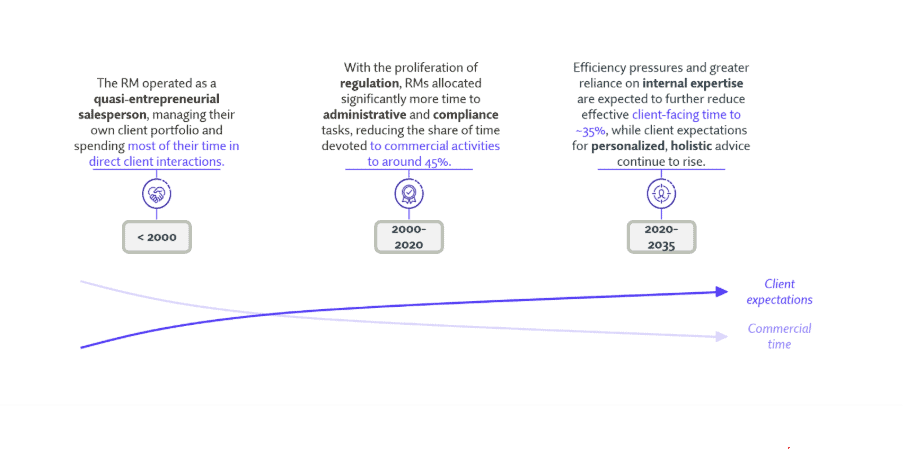
Client-facing time for Relationship Managers (RMs) has already declined to around 45% and could fall to approximately 35% over the next decade, according to recent Alpha studies. What it means to be a wealth manager today is markedly different from two decades ago: RMs once spent most of their time on client-facing commercial activities, but expanding regulatory requirements and internal controls have progressively pulled them into administrative and compliance-heavy tasks.
In parallel, wealth management technology is evolving rapidly, driven by modular architecture, low-code platforms and advances in Artificial Intelligence (AI). Yet in many institutions, RM tooling has developed incrementally, resulting in fragmented systems, duplicated processes and increased cognitive load rather than true efficiency gains. This combination of rising expectations, growing complexity and constrained RM capacity calls for a new front office operating model, one that fundamentally rethinks how RMs access information, prioritize actions and engage with clients.
1. From the RM Cockpit to an Intelligent Front Office
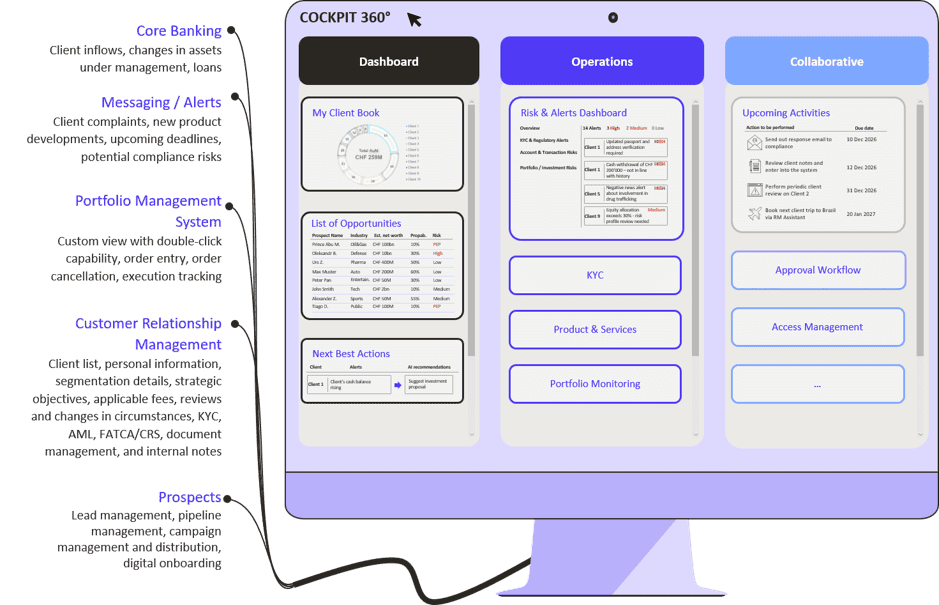
The RM cockpit itself is not new. The concept, a control-tower-style working environment centralizing client data, interactions, tasks and insights into a single 360-degree view, has featured in market discussions for years. The real innovation lies in the combination of the cockpit with AI: neither is new in isolation, but together they create an intelligent front office operating layer that centralizes information, guides workflows and improves day-to-day decision-making.
AI strengthens the cockpit by enriching data and surfacing actionable signals. It transforms fragmented or underused client information, such as meeting notes, transaction patterns and lifecycle events, into structured insights; it highlights commercial opportunities such as share-of-wallet growth potential, unadvised cash positions or early attrition signals; and it supports prioritization across entire RM books rather than individual portfolios.
Critically, the value lies in execution and scalability, not just insight generation. An advanced cockpit enables RMs to move from portfolio-level monitoring to client-level action in a few clicks: a flagged opportunity arrives with pre-assembled context, suggested talking points and a compliant next step, improving responsiveness, preparation quality and coverage capacity.
What Changes for Wealth Managers, and What Truly Differentiates
For wealth managers, the cockpit directly improves two critical indicators: time spent on client preparation and average response time to client requests. AI-driven decision support acts as a digital assistant to the RM, continuously surfacing follow-up actions and prioritizing opportunities based on client behavior and portfolio signals, enhancing rather than replacing RM judgment.
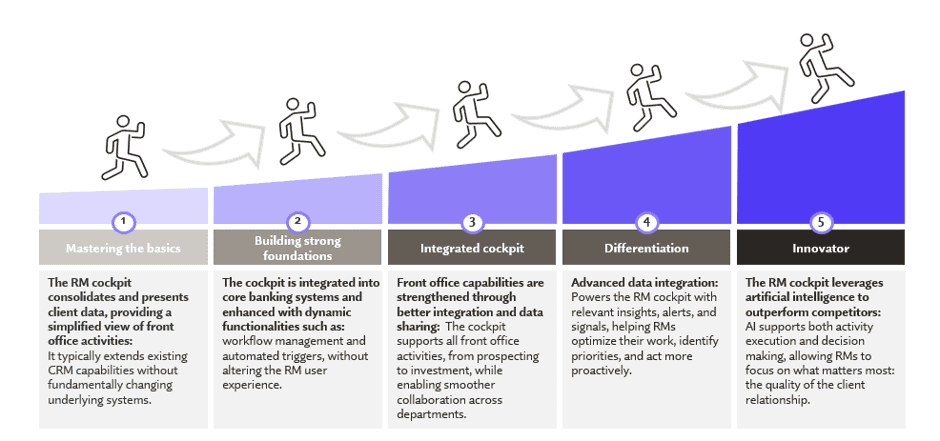
In our project experience, however, the true differentiators are the enabling capabilities and implementation constraints, not the front-end itself. Impact depends on a robust data architecture reconciling Customer Relationship Management (CRM), portfolio and interaction data; deep integration with core banking and advisory systems; recommendations embedded directly into daily workflows, not a separate dashboard; and the ability to deliver trusted, explainable suggestions despite legacy fragmentation and operational complexity. As Figure 3 illustrates, most firms remain at foundational or integrated-cockpit stages; those that combine data, workflow, automation and agentic support within a single platform can move decisively ahead.
How Can Alpha help?
The RM cockpit enables capabilities such as unified client views, intelligent prioritization and workflow automation, but its value extends further: firms realize that value only when design, implementation, adoption and operating model evolve together. This is where Alpha brings proven experience.
We have supported leading wealth managers across this full journey: defining cockpit target states and business cases, designing data and integration architectures, selecting and configuring vendor platforms, and driving RM adoption through Key Performance Indicator (KPI) frameworks tracking preparation time, response time and share-of-wallet development. By combining deep wealth management expertise with pragmatic delivery capabilities, we help firms translate strategic ambition into measurable commercial and client outcomes.
We would be happy to discuss any challenges your organization may be facing and share relevant insights on how to address those challenges, so please get in touch.