


This paper observes the growing importance of the global insurance brokerage market and highlights the key themes which suggest actions are required if this is to continue. A transatlantic analysis in selected markets is undertaken, with key implications identified for different broker archetypes. At Alpha FMC, we have deep experience of working with leading insurance brokers on the areas discussed and are in a strong position to provide relevant support.
GROWING IMPORTANCE OF THE MARKET
The global insurance brokerage market is estimated to grow from US$128b in 2021 to US$278b in 2030[i] at a Compound Annual Growth Rate (CAGR) of 16%. This outperforms the global commercial insurance market, which is only projected at a CAGR of 10%[ii] at the same time. This is due to:
- Increased demand for independent risk advisory in the more complex commercial/specialty lines
- Growth opportunities as brokers effectively own the client relationships more than (re)insurers do
- Non-risk bearing ‘trader’ model with focus on core activities and less balance sheet volatility
Globally, broker distribution has gained shares over agency and banca channels, with the advantage of being more client-centric and carrier-agnostic alongside deep expertise and broad networks. While the direct channel has overtaken the intermediaries for personal lines in some markets, there has been a significantly lower impact in commercial insurance due to complexity of the latter.
COMPETITIVE LANDSCAPE IN SELECTED MARKETS
In this transatlantic competitive analysis on selected markets (i.e., UK, US and France), brokers are classified by scale into Global Brokers, Challenger Brokers and Niche Brokers.
Global Brokers: The ‘Big Three’ (i.e., Marsh, WTW and Aon) in Europe, and the ‘Big Four’ (‘Big Three’ and Gallagher) in the US
Challenger Brokers: Scaling challengers (e.g., PIB, Lockton and Verlingue) to Global Brokers, with market-unique definition, e.g., UK: Top 20 ex-Big Three, Annual Income >£100m, US: Top 35 ex-Big Four, Annual Income >US$200m, France: Top 20 ex-Big Three, Annual Income >€25m
Niche Brokers: Players not meeting the criteria of Challenger Brokers, typically niche and specialist operating in a smaller number of markets and/or lines of business
United Kingdom
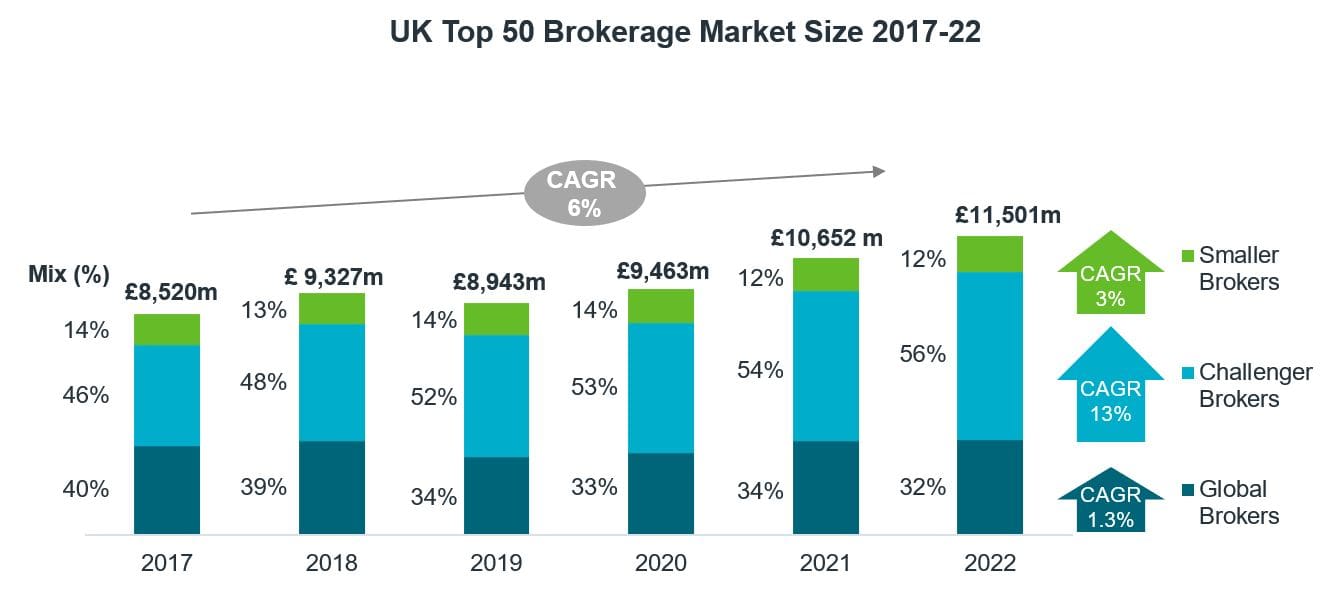
The UK has become more concentrated with the Top 10 brokers accounting for 74% of the income generated by the Top 50. Although the UK still contributes the largest share of European M&As, the number of broker deals has declined since 2021. Private Equity (PE) firms still back most of these transactions due to strong multiple incentives, but this is also on a declining trend. Challenger Brokers achieved double the market-average growth, with most reporting double digit CAGR in 2017-22. Global Brokers experienced stable growth, while hundreds of Niche Brokers have been acquired since 2021.
United States
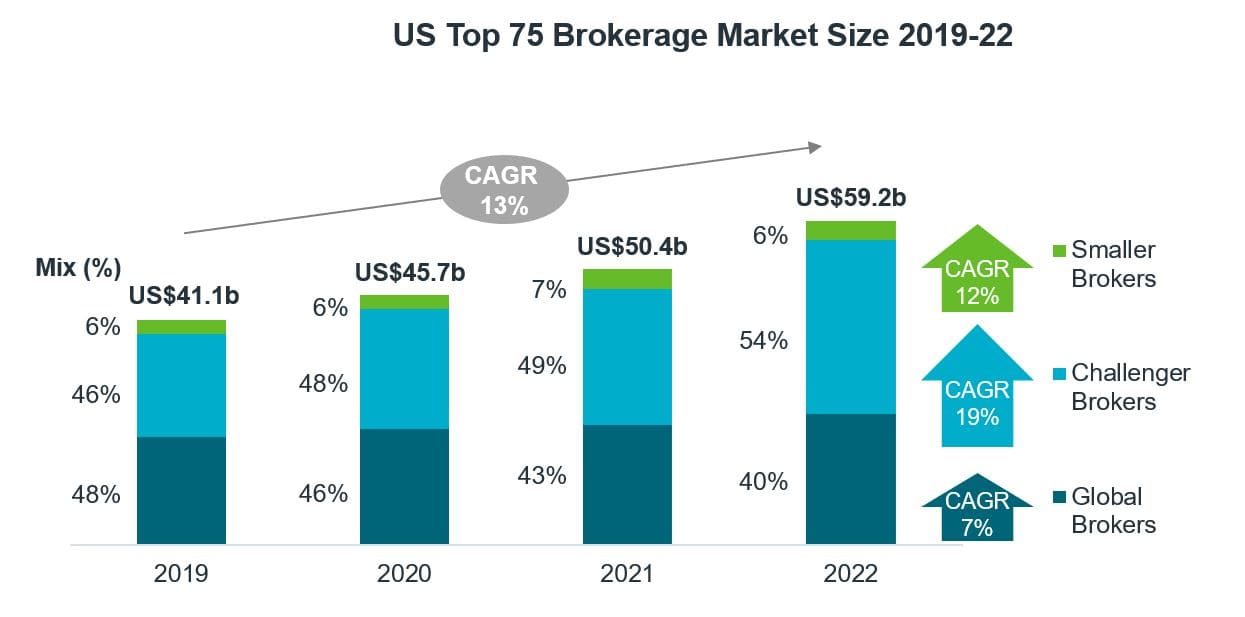
The US market remains concentrated with the Top 10 brokers accounting for 67% of the income generated by the Top 75. The number of broker deals overall (predominantly PE-backed) decreased in 2022, similar to observation in the UK. Challenger Brokers achieved 1.5x of market-average growth over the past few years, with 9 of them experiencing a CAGR of 40% or above. The majority of these brokers are also PE-backed. Global Brokers experienced stable growth, while thousands of Niche Brokers have been acquired since 2021.
France
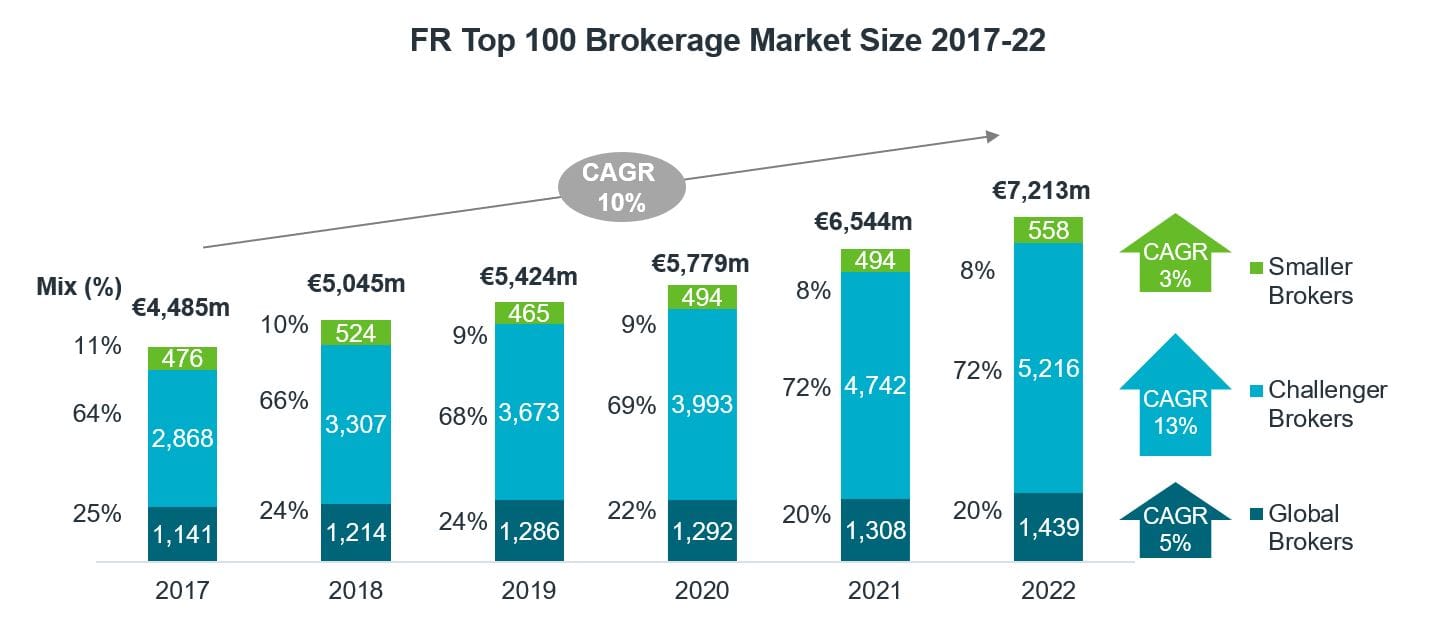
France is increasingly concentrated with the Top 10 brokers accounting for 60% of income generated by the Top 100. Unlike the UK and the US but aligned to Europe overall, France observed an uptick in brokerage M&A during 2021-22, with a slight slowdown in 2023 and activity is set to intensify over the coming years. Challenger Brokers have been on an upward trajectory, with above-market growth of 13% fueled by PE-backed M&A. Global Brokers experienced stable growth in France, with Niche Brokers often acquisition targets.
THEMES DEFINING THE FUTURE OF THE MARKET
We see six key themes defining the future of global insurance brokerage market.

BROKER ARCHETYPES AND IMPERATIVES
From our experience of working in the market, we have identified four main broker archetypes. We use ‘archetype’ as a way of classifying the broker’s strategic priorities. However, it should be emphasized that these are not mutually exclusive and that most players aspire to excel in more than one area.
- Growth Pursuer: Actively pursuing growth opportunities, often through mergers and acquisitions, to scale up operations and challenge larger competitors
- Experience Innovator: Prioritizing innovation and technology, offering digitalized and streamlined processes to enhance customer and distributor experiences
- Regional Networker: Focusing on building extensive networks, these brokers provide clients with access to a wide range of insurance solutions
- Specialist: Specializing in one or more insurance lines, these brokers leverage their expertise across one or more sectors to cater to diverse client needs
For each of the six market themes, we have further developed some imperatives and rated the level of importance for each broker archetype.
1. Strategy & Deals
- With a higher cost of capital, stronger emphasis should be placed on post-merger integration alongside acquisitive growth strategies
- Organizational and cultural alignment should be prioritized so that broking divisions and functions from different entities can collaborate effectively
- Inflationary environments demand improved cost synergy realization and improved scalability

2. Customer & Digital
- Increased focus on exclusive partnerships with both carriers and insurtechs on distribution as well as analytics to inform product and service design
- Expanded services via vertical integration (e.g., Delegated Authority, Managing General Agent)
- Improved market connectivity underpinned by a modernized placement platform, as digital end-to-end integrated systems and data are becoming more essential

3. Data Management
- Stronger focus on data centralization/integration being the foundation for analytics and data-driven decisions (e.g., risk and claims assessment), with greater investments in cloud solutions for increased accessibility, efficiency & scalability
- Brokers need to further leverage databases/warehouses to monetize data held (e.g., cross/upselling analytics) and identify cost savings (e.g., operational analytics)

4. People Management
- Brokers need to further optimize the remote/hybrid model while maintaining effective collaboration and client contact, alongside promoting D&I and well-being initiatives
- Sales and non-sales digital enablement, automation and productivity initiatives should be in razor focus as it remains important to staff engagement
- With increasing use of AI and technology, Learning & Development programs should cover the key skills required

5. Platform Modernization
- Continuing the modernization of placement platform and core systems (e.g., PAS, EPM) to encompass customer and distributor portals, empowering seamless and efficient services
- Improving return on IT investment as legacy systems remains a barrier to cost efficiency

6. Operational Excellence
- Enhancing process efficiency through simplification, automation, centralization, and right-shoring. Increased focus should be placed on realizing post-merger cost synergies
- Effective change management and communications during major transformations
- Thorough cost and benefit analysis applied to measure the success of prioritized initiatives

CONCLUSION
The insurance brokerage market has seen substantial growth; however, long-term success requires an effective response to the emerging trends and challenges. The six key themes identified in this paper are the crucial areas of focus for continued progress. Brokers, irrespective of scale or archetype, must consider these if they are to successfully navigate an evolving market.
HOW ALPHA CAN HELP
At Alpha FMC, we have significant experience advising on these critical focus areas discussed and are in a strong position to provide relevant support to existing and prospective clients. Our Insurance Team has deep experience of working with leading insurance brokers on strategically important initiatives such as target operating model design, post-merger integration, digital and data transformation, ESG, risk and regulatory change.
If you would like to discuss more, please get in touch with us here.
REFERENCES:
i. Zion Market Research (https://www.zionmarketresearch.com/report/insurance-broking-market)
ii. Allied Market Research (https://www.alliedmarketresearch.com/commercial-insurance-market-A11665)