


Limited Partners have long used a GP’s commitment to its own fund as shorthand for alignment: bigger number, more skin in the game, checked once at diligence and rarely revisited. That is starting to break down. A new class of financing vehicles now helps GPs fund that commitment without selling equity in the management company, and the more relevant question for LPs is no longer how much the GP committed, but how commitment was financed.
Participation and Interest
Equity GP stakes sales have been a prominent route for GPs seeking capital to fund their commitment. However, fundraising for the strategy has weakened, relatively speaking. Dedicated GP stake funds closed on $4.35 billion in 2025, against a 2022 peak of nearly $16 billion (Sutton, 2026).
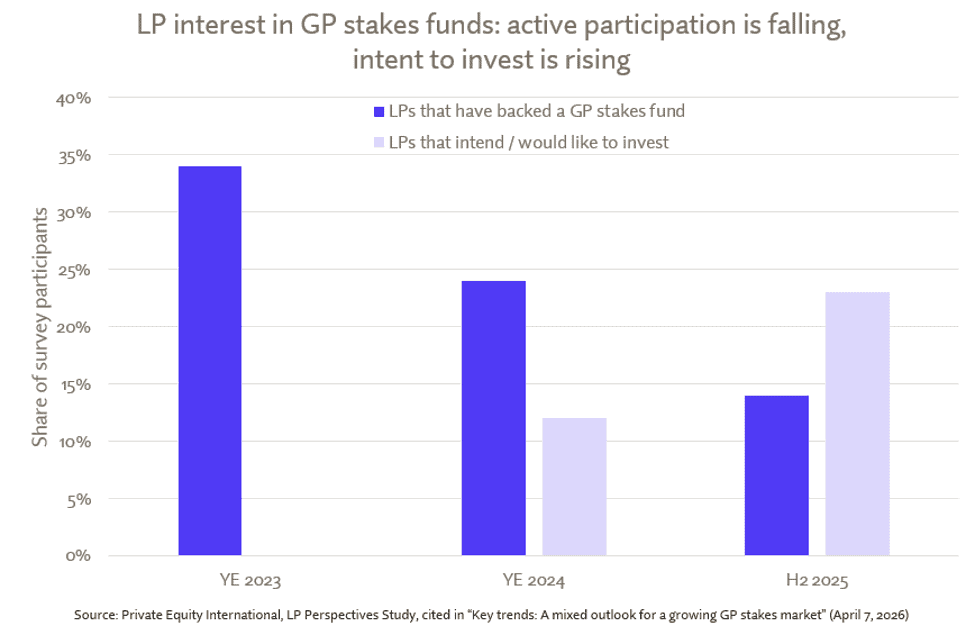
This does not indicate that LP appetite for exposure has disappeared. As the chart below shows, active participation in GP stakes funds has fallen sharply since 2023, while the share of LPs saying they intend or would like to invest has nearly doubled over the same period (Sutton, 2026).
The New Playbook
Alongside stakes, a newer category of structured GP financing has emerged: capital provided to GPs for specific needs, in some cases including funding the GP’s own fund commitment, without the permanent dilution of a stake sale. Arctos Partners’ debut vehicle, Keystone Fund I, closed on $6.2 billion against a $4 billion target (Zhang, 2026). The category extends beyond Arctos: PEI reports that Dawson Partners raised $840 million in March for its second programme dedicated to GP financing, and that Inceptiv has been marketing strategies that help managers fund their GP commitments and partially monetize accrued carried interest (Zhang, 2026).
The Alignment Question
The reason this matters comes back to why commitment size is tracked at all. Research from the Institute for Private Capital, drawing on 1,503 private equity funds over more than 20 years, found that bigger GP commitments are associated with better fund performance, up to an estimated optimal range of 10 to 13 percent of committed capital. That holds up as you look at it with statistical controls or simply compare funds by commitment size. The chart below shows average IRR and MOIC both rise moving from low to mid to high commitment groups (Brown & Volckmann, 2024). The average GP commitment across the full sample was just 3.5 percent, well short of that optimal range.
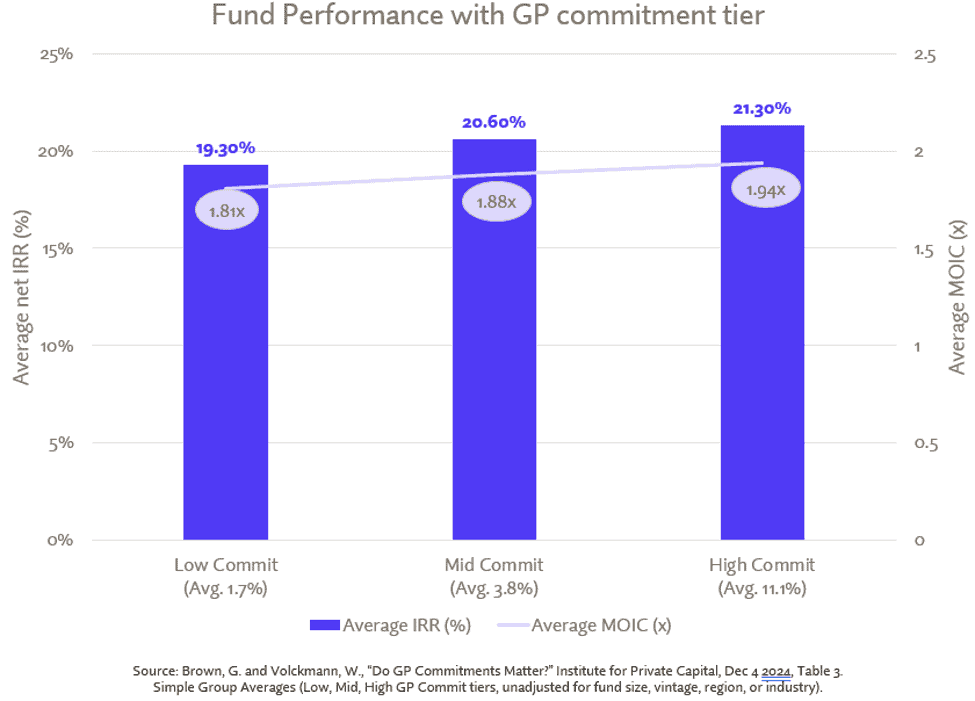
That relationship assumes the commitment itself is the same kind of capital across funds. The same researchers caution that this isn’t true. How a GP’s commitment is structured or if stakes have been sold, could alter these incentive dynamics which the data couldn’t test (Brown & Volckmann, 2024).
Now, this structuring doesn’t signal a weakening alignment of the partners’ own pockets, but it is a different one. It does prompt the idea to add a short list of questions to diligence and monitoring on how the commitment is funded, whether repayment terms align with the fund’s own investment period, and if financing carries covenants or triggers that could shape GP decisions.
Looking Ahead
LP diligence has matured this way before. For instance, there was an observable trend towards increased scrutiny and transparency of carried interest and waterfalls, which became key areas of negotiation in fund documentation. It’s reasonable to argue that GP commitment financing is on the same trajectory given how fast dedicated financing vehicles are scaling. The firms building these structures already have precise language for them. Most LPs evaluating the funds behind them do not, and that difference could start to matter.
How Alpha Can Help
Alpha helps institutional investors adapt quickly as private market winds shift. We support client initiatives that:
- Evaluate the operational and governance implications of GP architecture and ownership structures.
- Design scalable monitoring and reporting processes that improve transparency across managers and portfolios.
- Enhance data management and analytics capabilities to support stronger oversight and decision-making.
- Assess target operating models and control frameworks to address potential risks introduced by new financing structures.
- Implement practical solutions that connect findings to ongoing portfolio monitoring and governance.
By translating new and emerging market developments into practical requirements from clients and operating solutions with vendors, Alpha enables investors to make more informed investment decisions and maintain confidence that investment interests remain aligned with objectives. If your organization is looking to solidify diligence frameworks to reflect these newer financing structures, we’d welcome the conversation.
References
Brown, G., & Volckmann, W. (2024, December 04). Do GP Commitments Matter? Retrieved from Institute for Private Capital: https://uncipc.com/publication/do-gp-commitments-matter/
Sutton, J. (2026, April 07). Key trends: A mixed outlook for a growing GP stakes market. Retrieved from Private Equity International: https://www.privateequityinternational.com/
Zhang, H. (2026, July 13). Fundraising: ‘Self-liquidating’ helps Arctos make a $6.2bn GP financing debut. Retrieved from Private Equity International: https://www.privateequityinternational.com/