


Introduction
It has been widely commented that it is a seller’s market across Wealth Management and Financial Planning. In this article we take a step back to consider “so what?” and offer recommendations to assist buyers to identify and increase value both pre- and post-deal. Without them, firms risk paying an irredeemable premium or having to step away and lose out on the coveted target.
While there are too many factors to discuss in one article, we have brought together three that strike as being either topical or often under-prioritized.
- Pre-Deal Integration Planning: Identifying where the value lies and ensuring this is protected, while recognizing the restrictive environment during pre-deal
- Pre-Deal Cultural Differences: Gauging cultural considerations early in the process and with a robustness that meets its importance as a driver of value
- Execution: Implementing an effective governance model to drive execution of the plan and ensure synergy realization
Pre-Deal Integration Planning
Building realistic integration plans are challenging, particularly between firms operating in different market segments – for example when Financial Planning and Discretionary Fund Managers come together. So where do we see opportunities to improve?
Firstly, retention of clients and key staff is core to the success of integration. Most firms will enact integration strategies to explicitly protect these stakeholders (retention plans, communications, value propositions, etc.), but only to undermine it with a poorly executed integration. The reality is that a well-considered, communicated and executed implementation plan will itself create lower attrition rates, with its positive momentum creating knock-on benefits.
Secondly, we encourage being realistic, and not optimistic when constructing plans. The industry is littered with plans that in reality were not feasible, or overly dependent on fragile synergies that never materialized. Joint Venture or similar strategies – keeping the target separate for a spell – mitigates the restricted time and information upfront that can lead to overly optimistic plans.
However, if deal valuation is contingent on realizing these synergies, there are some priority areas that are too often ignored. We rarely see working assumptions on client and product data, which then end up stalling while trying to rush a decision on “which CRM is best?” once the deal is done. Equally, some core systems are known to be easier than others at combining or subsuming others. This on its own contributes massively to the legacy mosaic of risky operating models across the industry. If in need, specialist business architects can quite rapidly build decent pre-deal assumptions.
Pre-Deal Cultural Differences
Factoring in cultural differences between merging / acquiring firms is commonly referenced as one of the critical components to successful M&A, but a recent poll indicated that less than a fifth of leaders would treat it with the same rigor as financials.
Cultural dynamics within a single firm can be hard to fathom, and between firms much more so. To get it wrong puts deal value significantly at risk: the one-to-many relationship between advisers and their clients amplifies the revenue impact of each advisor exit, to say nothing of wider risks including morale, operational resilience and even litigation. Ultimately, the two cultures will soon be working intensely to execute the plan.
Given it is high on sponsors’ agendas and creates material value, why is it under-analyzed? The most likely reason is because it is complex and there is no commonly-agreed formula for doing so, unlike financial modeling.
To overcome this, Alpha has established a Culture Due Diligence approach based on the Competing Values Framework, providing an efficient method of identifying organization cultures based on key indicators.
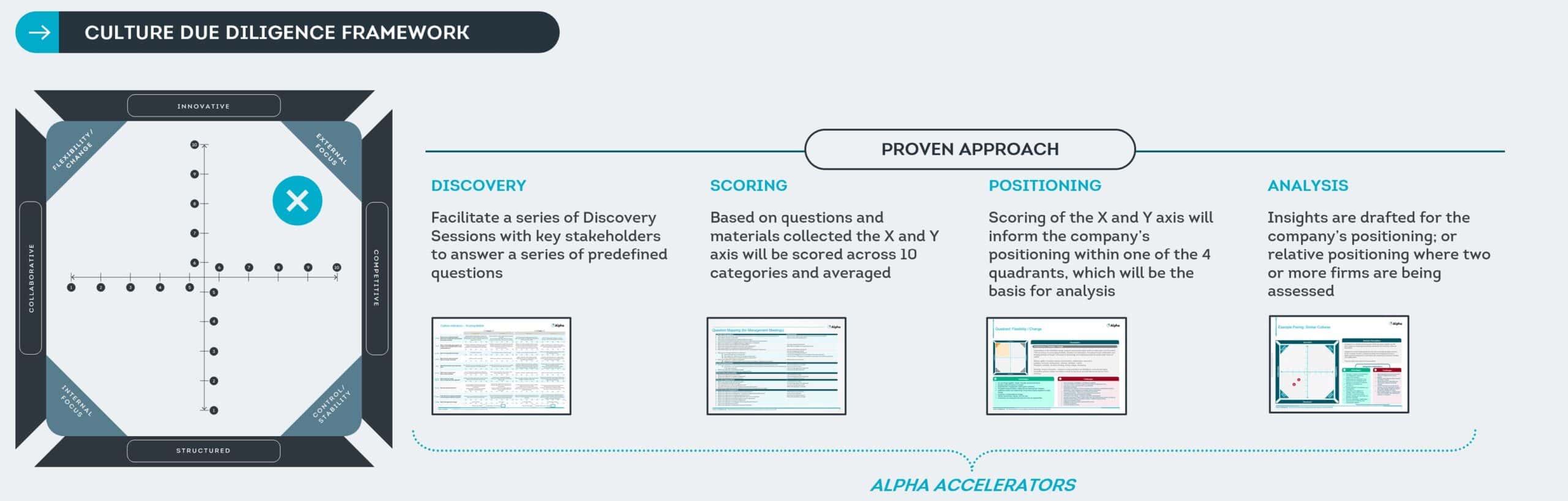
We see a lot of value in this approach, specifically because:
- It creates standard guidelines on cultural fit, to create a consistent language when comparing organizations;
- Identifies likely headwinds and opportunities across multiple aspects of culture, allowing more targeted action when executing the integration;
- Integrates with common due diligence approaches, allowing the outputs to be easily digested and all without expending significant effort.
Regardless of the approach you choose, we recommend taking care that it delivers to the standards warranted of such a value-sensitive factor.
Execution
Once the plan is in place and the cultural landscape understood, the focus turns to execution.
During the effort to mobilize, one of the earliest activities is resourcing. It is a certainty that M&A will impact the target organization from front to back but so often, execution teams have large gaps in representation, leading to pain further down the line. A little extra time refining a team-sheet and communicating responsibilities – or better still, establishing as part of a playbook – will offer huge reward for the time taken. And it’s not only ensuring you have wide enough representation: not having enough resource is damaging for long term success as project staff get burnt out, milestones get missed, and stakeholders become frustrated. Most wealth firms do not have standing armies of project managers and a Project Management Office that operate independently to protect BAU. Commonly, firms tactically backfill essential roles for the project’s use, while augmenting these with external resources, and the most prudent are rigorous in managing the existing change-load to acceptable levels. Particularly for those sizing these projects for the first time, it warrants some care and analysis upfront, to avoid a faltering start to execution.
Like any substantial project of this kind, M&A execution requires a carefully established governance structure that reflects the businesses, the resourcing model and the cultures internally.
Our advice is that this model doesn’t need to be overly complicated and borrowed from pioneers but should reinforce the natural dynamics of the firm using it. Individuals need to be accountable and feel they can make a difference; the group as a whole needs clear direction and motivation; sponsors need to understand progress and be able to clear blockages; efforts should be amplificatory and not duplicated. There are multiple ways to achieve this but probably not that many that fit your firm. Ultimately, if you choose to engage an external firm to assist in execution, ensure they recognize your nuance, and do not rely on the ‘standard’.
Conclusion
With the frenetic deal market in Wealth Management today, it’s never been so important to seek marginal gains, recognize limitations and keep to priorities. Be as specific and focused with your plan as possible and find every opportunity to maximize positive momentum for the change. This will in turn reinforce your direct plans to limit advisor and client attrition. While planning out your People approach, consider bringing in support to map out the cultural differences upfront, giving it the attention it deserves. And sometimes, it’s helpful to have an objective partner to talk to.
To learn more or speak to one of our experts, please reach out to Alpha.