


Through 2026, organizations will abandon 60% of AI projects unsupported by AI-ready data (Gartner, 2025). The competitive pressure wealth managers are facing has never been more acute.
Productivity is under strain as teams struggle to scale personalized service. Client expectations are evolving faster than firms can adapt. Digital-native competitors are reshaping the landscape. And costs keep climbing, squeezing margins while demand for sophistication grows.
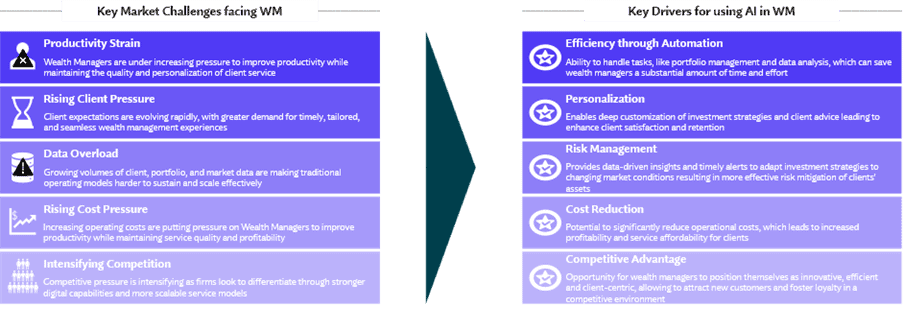
In this environment, artificial intelligence is not optional anymore; it has become existential. AI offers the promise of unlocking efficiency through automation, delivering hyper-personalized client experiences at scale, embedding data-driven risk management into every decision, and fundamentally reshaping how wealth is managed.
But here is what most firms have yet to understand: AI projects are not failing because of the algorithms. They are failing because of the data.
This is not speculation anymore; it is what we observe across the industry. Firms invest heavily in AI initiatives, assemble talented teams, and select sophisticated tools. Yet 60% of these projects stall before generating measurable business value (Gartner, 2025). The reasons are poor data quality, fragmented systems, murky ownership, weak governance and an inability to surface business meaning from raw data. You cannot build AI on a foundation of sand.
The firms that will win in the next decade are not those with the flashiest AI models. They are the ones who recognize a fundamental truth: data is the asset. AI is what you do with it.
Data: the unglamorous foundation of every AI success
The market’s focus on generative AI, large language models, and agentic systems creates a dangerous illusion: that technological advancement alone drives competitive advantage. In reality, these tools are only as effective as the data infrastructure supporting them. Firms investing in advanced AI without first fixing their data foundations will face predictable failure.
Consider the practical blockers that derail AI initiatives:
- Fragmented data spread across incompatible systems creates inconsistency that puts banks and their clients at risk. Teams operate on different versions of truth, risk models cannot trust portfolio data, and compliance cannot rely on client records. The result is fractured decision-making, blind spots in portfolio risk assessment, and the possibility of misaligned or poorly monitored client positions.
- Absence of a golden source of truth means terminology shifts across departments. What counts as revenue in one system does not match another. What one team calls a “client relationship” another calls a “household.” This semantic chaos makes it nearly impossible for AI to interpret data consistently or for humans to trust what AI outputs.
- Limited integration between business processes and AI workflows means AI insights never make it into day-to-day operations. A model might predict which clients are at risk of attrition, but if that prediction stays buried in a data mart, it is useless. AI delivers value only when teams embed it in how people actually work.
- Data access and ownership ambiguities create bottlenecks with data sitting locked in legacy systems and IT controlling the gates. Data teams cannot move fast enough, and business teams cannot self-serve. Innovation slows to a crawl.
- Poor data quality, whether through stale records, missing fields or incorrect values corrodes confidence. Business leaders hesitate to act on AI recommendations when they do not believe the underlying data. AI-driven decision-making gets resisted, scaled cautiously, or abandoned entirely.
These are not technical edge cases; they are the norm. They are why promising AI projects languish. And they are why data quality, combining robust infrastructure with rigorous governance and cleansing, has become the real competitive battleground in wealth management.
The path forward: three pillars of AI-ready data
Fixing this requires more than incremental improvement. It requires building three core capabilities that work together as an integrated system:
Pillar 1: Enterprise data storage
At the foundation is centralized, structured storage. This means consolidating data, both structured and unstructured, into a unified architecture where teams can organize, validate, and make it accessible at scale.
Why this matters: When fragmented systems split data, no single view of reality is possible. A client’s investment preferences might sit in one system, their risk profile in another, their communication history in a third. Building a coherent AI system is nearly impossible.
Enterprise data storage creates the foundation for consistency. Teams consolidate structured data into centralized repositories: data lakes (repositories of raw data from multiple sources) and data warehouses (refined, organized data optimized for business use). Teams can then organize, deduplicate, and standardize these datasets. Teams can index unstructured data (emails, documents, meeting notes, etc.) and make it retrievable. Data validation and cleansing processes can run systematically, improving quality across the board.
The result is what firms need most: a single, trustworthy source from which AI systems can draw.
Pillar 2: Data mesh with clear governance
But centralization alone is not enough. The second pillar is governance that actually scales: a data mesh architecture.
Traditional governance tries to enforce consistency through policy, a central data team manages everything, rules flow down, compliance is monitored. This works at small scale, but as firms grow, as data volumes explode, as new use cases multiply, as regulatory complexity increases, centralized governance becomes a bottleneck. The data team cannot move fast enough; business teams get frustrated and quality still suffers.
A data mesh flips this model. Instead of central control, you create domains, each business function, whether Front Office, operations, risk or compliance, becomes responsible for its own data products. The wealth management team owns client and portfolio data. Operations owns process data. Risk owns market and exposure data.
What this enables: Domain experts build data products tailored to their business context. They understand the nuance, the exceptions, the edge cases that a central team never could.
Federated governance is the connective tissue. Clear data ownership, defined responsibilities, standards that domains must meet but autonomy in how they achieve those standards. Self-serve data architecture lets AI-powered teams access and experiment with data without bottlenecks.
The result is both agility and trust. Business teams move faster because they are not waiting for permission. Quality improves because domain experts own their data. And the organization learns to treat data as a managed asset, not a compliance headache.
Pillar 3: Semantic layer – bridging data and meaning
The third pillar is perhaps the most underrated: the semantic layer.
Technical data structures are built for storage and computation. They are efficient but they are often opaque to business users. A “field_003” might represent client age. A “var_x_t_minus_1” might represent lagged market volatility. These structures mean nothing to a portfolio manager or a compliance officer. They are meaningless to AI systems that are supposed to reason about business logic.
A semantic layer translates between technical data and business reality. It creates an ontology, a structured representation of domain concepts and their relationships. Client relationships map to households. Transactions map to portfolio movements. Market data maps to benchmark comparisons. Teams make these mappings explicit, documented, and accessible.
Why this matters for AI: When you equip AI systems with semantic understanding, they reason more intelligently. An AI system that knows “household” is a collection of related clients makes better recommendations. An AI system that understands market context makes better risk assessments. An AI system equipped with semantic understanding can automate anti-money laundering (AML) risk scoring by correlating client relationships, transaction patterns, and behavioral signals, catching compliance violations that siloed data systems miss.
The semantic layer also democratizes data. Business users can interact with data in terms they understand. “Show me the assets under management for high-net-worth households” becomes a straightforward query instead of a coding challenge. This shifts the culture from “data is for analysts” to “data is for everyone.”
It is the difference between having data and being data-driven.
How the pieces fit together
Enterprise storage, data mesh, semantic layer – individually, each is valuable, while together, they create a virtuous system:
Enterprise storage centralizes and standardizes data, creating consistency and accessibility. The data mesh distributes governance and accelerates delivery without sacrificing quality. The semantic layer injects business meaning, turning raw data into intelligence that the organization can actually use.
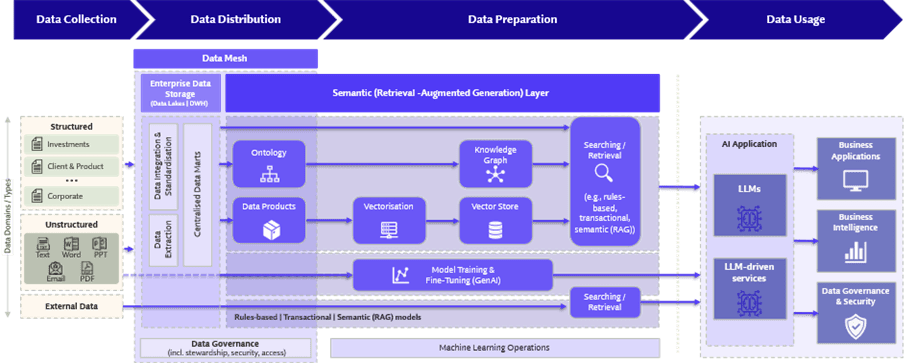
When these three work in concert, something else happens: data becomes a true asset. It flows freely across the organization. Teams trust it, access it easily, and it speaks to the business, not just to IT. And teams can build AI systems on this foundation without constantly hitting the same blockers that derailed previous efforts.
Forget pilots and prototypes. This integration is what creates “AI readiness”: sustainable, scalable, embedded AI that actually changes how wealth is managed.
The competitive imperative
Here is what matters strategically: firms that build these foundations now will be the ones defining the next era of wealth management. Their AI systems will work. Their clients will get better experiences. Their teams will operate more efficiently. Their risks will be better managed.
Firms that do not, that hope pilots will somehow turn into systems, will find themselves increasingly squeezed. Differentiation will narrow, margins will compress, the competitive gap will widen faster than they can catch up.
This is not theory. It is what is already happening across the industry. The firms that started treating data infrastructure as a strategic priority three years ago are now deploying AI that actually works. The ones that bet on technology alone are wondering why their models are not generating value.
The inflection point is now. The firms that get their data house in order, that invest in storage, governance, and semantic meaning, will be positioned to capture the value that AI promises. The ones that treat it as a technology problem will continue to struggle.
The question is not whether your firm needs AI. It is whether you are building the data foundation to make it succeed.
To discuss how to build AI-ready data foundations, please complete the form and we will connect you with the right person.