


For anyone who has worked in real estate asset management, the workflow is painfully familiar: you run your property cashflows in ARGUS Enterprise, export to Excel, build a debt model on top, layer in your exit assumptions, and somehow try to roll it all up at the portfolio level. Then a rate assumption changes, and you do it all again.
This is the state of the art for many of the world’s largest real estate investors in 2026. And it shouldn’t be.
ARGUS Enterprise is the undisputed industry standard for property-level cashflow modeling and valuation, and for good reason. Its methodology is trusted by buyers, sellers, lenders, and auditors alike. We’re not here to replace it.
What still happens in Excel
For many real estate investors and asset managers, key portfolio planning activities still take place outside core underwriting systems in Excel. Debt modeling, refinancing schedules, disposition proceeds, portfolio roll-ups, and sensitivity analysis are often managed through separate spreadsheets and offline workflows.
On the other side, Anaplan is one of the most powerful financial planning platforms in the market, a Gartner Magic Quadrant leader, built on an in-memory calculation engine that handles complex, multi-dimensional models in real time. But Anaplan doesn’t come with a real estate cashflow model out of the box, nor native connections to lease management systems.
Two best-in-class tools. Neither complete on its own.
What we built
At Alpha Alternatives, we’ve spent years working with the largest institutional real estate investors in the world. We kept seeing the same pain points, and we finally decided to solve them properly.
We built an Anaplan model designed specifically to work alongside ARGUS, not replace it. Here’s how it works:
Property-level unlevered cashflows are exported from ARGUS and ingested directly into Anaplan via Cherre, our data integration layer. From there, the model layers in debt structures (fixed and floating rate, multi-tranche stacks, forward curves, amortization, refi assumptions) and disposition modeling (exit cap rates, terminal values, net proceeds) to produce a true levered net cashflow to equity.
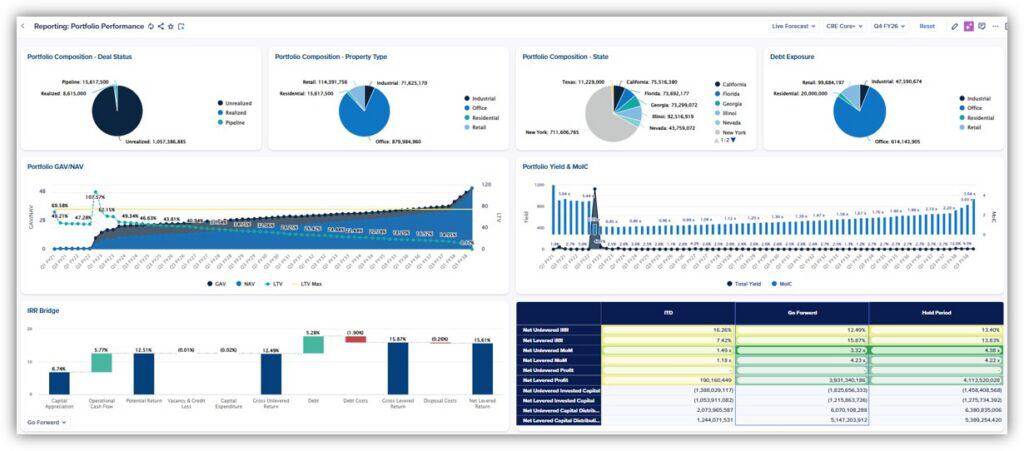
The result is a consolidated, real-time view across the entire portfolio: IRR, MoIC, DSCR, loan maturity profiles, cap rate exposure, all in one place, all connected.

The part that changes how you work
The single most valuable feature isn’t the modeling. It’s the scenario analysis.
With everything connected, users can stress-test assumptions across the full portfolio in seconds: cap rates, interest rate curves, LTV ratios, disposition timing. What used to take days of Excel work becomes an instant sensitivity run.
For investment committees, this is transformative. Instead of presenting a single base case, managers can walk through a full range of scenarios, stress-tested and consistent across every asset in the fund.
Why this matters now
Real estate managers are navigating a uniquely complex environment: elevated rates, refinancing risk, cap rate uncertainty, and increased scrutiny from LPs and regulators. The tools need to match the moment.
The ARGUS + Anaplan architecture we’ve built and refined across dozens of client engagements does exactly that. It preserves the industry-standard valuation methodology everyone trusts, while delivering the modern modeling, analytics, and collaboration capabilities that institutional managers actually need.
The observations above reflect decades of experience working across the real assets industry, and they remain true today, though it’s worth noting that every vendor mentioned is continuously evolving its platform, adding AI-powered features and sharpening its fit for our sector. As a specialized and technology agnostic firm, Alpha makes it our mission to stay on top of these developments and to best advise on the overall architecture as new features and AI capabilities come to market.
Modern portfolio decisions require more than property-level models. If you’re looking to reduce manual effort, improve scenario planning, and give investment teams real-time portfolio insight, let’s talk.
Douglas Eaton | Partner, Alpha Alternatives, the private markets division of Alpha FMC